Henry David Thoreau
1817–18628 books here
About Henry David Thoreau
Henry David Thoreau (born David Henry Thoreau) was an American author, poet, naturalist, tax resister, development critic, surveyor, historian, philosopher, and leading transcendentalist. He is best known for his book Walden, a reflection upon simple living in natural surroundings, and his essay, Civil Disobedience, an argument for individual resistance to civil government in moral opposition to an unjust state.
Thoreau's books, articles, essays, journals, and poetry total over 20 volumes. Among his lasting contributions were his writings on natural history and philosophy, where he anticipated the methods and findings of ecology and environmental history, two sources of modern day environmentalism. His literary style interweaves close natural observation, personal experience, pointed rhetoric, symbolic meanings, and historical lore; while displaying a poetic sensibility, philosophical austerity, and "Yankee" love of practical detail. He was also deeply interested in the idea of survival in the face of hostile elements, historical change, and natural decay; at the same time imploring one to abandon waste and illusion in order to discover life's true essential needs.
Biography from Open Library.
Henry David Thoreau books in order
The Maine Woods
The Maine Woods is a characteristically Thoreauvian book: a personal account of exploration, of exterior and interior discovery in a natural setting, conveyed in taut, workmanlike prose.
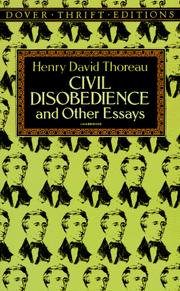
Civil Disobedience
Written with the motto "that government is best that governs least", when men are ready for it, that will be the kind of government we will have. This book tries to tell us to think for ourselves.
Walden
Walden first published in 1854 as Walden; or, Life in the Woods) is a book by American transcendentalist writer Henry David Thoreau. The text is a reflection upon the author's simple living in natural surroundings.
Cape Cod
Thoreau's account of his travels and explorations on Cape Cod is considered his most genial book, and one of his most appealing.
The writings of Henry David Thoreau
Naturalist, philosopher, champion of self-reliance and moral independence, Henry David Thoreau remains not only one of our most influential writers but also one of our most contemporary.
Journal
The conflict between scientific observation and poetry, reflections on abolition, transcendental philosophy, other concerns are explored in this superb general selection from Thoreau{u2019}s voluminous Journal.
Walking
If you are ready to leave father and mother, and brother and sister, and wife and child and friends, and never see them again, - if you have paid your debts, and made your will, and settled all your affairs, and are a…