Albert Camus
1913–196021 books here
About Albert Camus
Albert Camus was a French Algerian author, philosopher, and journalist who was awarded the Nobel Prize for Literature in 1957. He was a key philosopher of the 20th-century and his most famous work is the novel L'Étranger (The Stranger).
In 1949, Camus founded the Group for International Liaisons within the Revolutionary Union Movement, which was a group opposed to some tendencies of the surrealistic movement of André Breton. Camus was the second-youngest recipient of the Nobel Prize for Literature - after Rudyard Kipling - when he became the first African-born writer to receive the award. He is the shortest-lived of any literature laureate to date, having died in an automobile accident just over two years after receiving the award.
He is often cited as a proponent of existentialism, the philosophy that he was associated with during his own lifetime, but Camus himself rejected this particular label. In an interview in 1945, Camus rejected any ideological associations: "No, I am not an existentialist. Sartre and I are always surprised to see our names linked…"
Biography from Open Library.
Albert Camus books in order
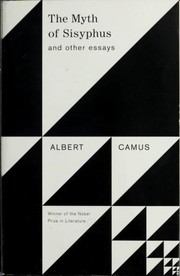
The Myth of Sisyphus
«Il n'y a qu'un problème philosophique vraiment sérieux : c'est le suicide.» Avec cette formule foudroyante, qui semble rayer d'un trait toute la philosophie, un jeune homme de moins de trente ans commence son analyse…
L’étranger
L'Étranger est le premier roman publié d’Albert Camus, paru en 1942. Il prend place dans la tétralogie que Camus nommera « cycle de l’absurde » qui décrit les fondements de la philosophie camusienne : l’absurde.
La Peste
The Plague (French: La Peste) is a novel by Albert Camus, published in 1947, that tells the story of a plague sweeping the French Algerian city of Oran.
Caligula, suivi de Le malentendu
M Caligula is a play written by Albert Camus, begun in 1938 and published for the first time in May 1944 by Éditions Gallimard. The play was later the subject of numerous revisions.
The Rebel
The Rebel (French: L'Homme révolté) is a 1951 book-length essay by Albert Camus, which treats both the metaphysical and the historical development of rebellion and revolution in societies, especially Western Europe.
L'exil et le royaume
"[Exile and the kingdom] consists of six "short stories". The term must be as loosely applied as was that of "novel" to last year's The Fall.
The Myth of Sisyphus and Other Essays
One of the most influential works of this century, this is a crucial exposition of existentialist thought.
La chute
Num bar de marinheiros em Amesterdão, um homem que se apresenta como juiz-penitente enceta conversa com um desconhecido.
Plays
CALIGULA, an attractive prince, upon the death of his sister and mistress, tries, through murder and the systematic perversion of all values, to practice a liberty that he will eventually discover not to be the right…
Les Possédés
Théâtre avec 23 personnages : 6 femmes, 17 hommes.
Resistance, Rebellion and Death
Essays selected by the author from his Actuelles.
Lyrical and critical
Concerned that he doesn’t “know any longer whether I’m living or remembering,” Camus tries to reconcile the intractable loss that is life, a digression which often reads more like prose poetry than essay.
A Happy Death
A young man searches throughout life for the key to confronting death without fear.
Great Short Stories of the World
The leader of the people / John Steinbeck Mr. Know-all / W. Somerset Maugham Vanka / Anton Chekhov The happy prince / Oscar Wilde The old demon / Pearl S. Buck The sailor-boy's tale / Isak Dinesen Young Archimedes /…
Le premier homme
"The First Man is a radiant, deeply moving novel of childhood. Camus intended it as the opening book of a projected epic - his War and Peace - but in its storytelling magic and its evocative power, it has a satisfying…