D. H. Lawrence

1885–19309 books here

Find authors like D.

About D. H. Lawrence

D.H. Lawrence was an English author, poet, playwright, essayist and literary critic. His collected works represent an extended reflection upon the dehumanising effects of modernity and industrialisation. In them, Lawrence confronts issues relating to emotional health and vitality, spontaneity, human sexuality and instinct. (Source.)

Biography from Open Library.

D. H. Lawrence books in order

  1. The white peacock

    D. H. Lawrence

    Lawrence's first novel is a compelling exploration of the estrangements of modern life. Focusing on three relationships - one destructively stillborn, one disastrously unfulfilling, and one passionately unspoken …

    368 pages1911

  2. Sons and Lovers

    D. H. Lawrence

    Sons and Lovers, a story of working-class England, is D. H. Lawrence’s third novel. It went through various drafts, and was titled “Paul Morel” until the final draft, before being published and met with an indifferent…

    491 pages1913

  3. Poems

    D. H. Lawrence

    A collection of short poems, mainly on themes suggested by the natural world.

    148 pages1913

  4. The Rainbow

    D. H. Lawrence

    (Brangwen Family #1)

    501 pages1915

  5. Women in Love

    D. H. Lawrence

    Dark, but filled with bright genius, Women in Love is a prophetic masterpiece steeped in eroticism, filled with perceptions about sexual power and obsession that have proven to be timeless and true.

    544 pages1916

  6. Lady Chatterley's Lover

    D. H. Lawrence

    Ours is essentially a tragic age, so we refuse to take it tragically. The cataclysm has happened, we are among the ruins, we start to build up new little habitats, to have new little hopes.

    359 pages1928

  7. Short stories

    D. H. Lawrence

    "In his introduction, James Lasdun discusses the theme of liberation and the ways in which it is conveyed in these works.

    307 pages1928

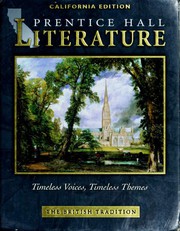
  8. Prentice Hall Literature - Timeless Voices, Timeless Themes - The British Tradition

    Kate Kinsella, Kevin Feldman, Colleen Shea-Stump Ph.D., Joyce Armstrong Carroll, Edward E. Wilson, Joseph Addison, Anna Akhmatova, Yehuda Amichai, Matthew Arnold, W. H. Auden, Jane Austen, Joanna Baillie, Bashö, Charles Baudelaire, Bede, Bei Dao, James Berry, Tony Blair, William Blake, Eavan Boland, Robert Bolt, Jorge Luis Borges, James Boswell, Elizabeth Bowen, Charlotte Brontë, Emily Brontë, Brooke, Rupert, Elizabeth Barrett Browning, Robert Browning, Robert Burns, Buson Yosa, Lord Byron, Tracy Chapman, Geoffrey Chaucer, Winston S. Churchill, Arthur C. Clarke, Samuel Taylor Coleridge, Confucius, Joseph Conrad, Daniel Defoe, Anita Desai, Charles Dickens, John Donne, T. S. Eliot, Elizabeth l, Queen of England, Anne Finch, Mohandas Karamchand Gandhi, Nadine Gordimer, Thomas Gray, Graham Greene, Thomas Hardy, Seamus Heaney, Heinrich Heine, Robert Herrick, Ὅμηρος, Gerard Manley Hopkins, A. E. Housman, Ken Hughes, Ted Hughes, Kobayashi, Issa, Thomas Jefferson, Francis Jeffrey, Samuel Johnson, Ben Jonson, James Joyce, John Keats, Rudyard Kipling, Amelia Lanier, Philip Larkin, D. H. Lawrence, Doris Lessing, Richard Lovelace, Thomas Babington Macaulay, Louis MacNeice, Thomas Malory, Christopher Marlowe, Andrew Marvell, Catherine McGuinness, John Milton, Thomas More, Saki, V. S. Naipaul, Pablo Neruda, Sir Isaac Newton, George Orwell, Ovid, Wilfred Owen - undifferentiated, Margaret Paston, Samuel Pepys, Francesco Petrarca, Edgar Allan Poe, Alexander Pope, Anna Quindlen, Walter Raleigh, Redgrove, Peter., Arthur Rimbaud, Sappho, Siegfried Sassoon, William Shakespeare, Mary Shelley, Percy Bysshe Shelley, Sir Philip Sidney, Alan Sillitoe, Stevie Smith, Sydney Smith, Sophocles, Muriel Spark, Stephen Spender, Edmund Spenser, Suckling, John Sir, Jonathan Swift, Alfred Lord Tennyson, Dylan Thomas, Emma Thompson, William Trevor, Tu Fu, Suzanne Vega, Derek Walcott, Mary Wollstonecraft, Virginia Woolf, William Wordsworth and William Butler Yeats

    1305 pages2002