Daniel Defoe

1660–17315 books here

Find authors like Daniel

About Daniel Defoe

Daniel Defoe, born Daniel Foe, was an English writer, journalist, and pamphleteer, who gained enduring fame for his novel Robinson Crusoe. Defoe is notable for being one of the earliest proponents of the novel, as he helped to popularise the form in Britain, and is even referred to by some as among the founders of the English novel. A prolific and versatile writer, he wrote more than 500 books, pamphlets, and journals on various topics (including politics, crime, religion, marriage, psychology and the supernatural). He was also a pioneer of economic journalism. (Source)

Biography from Open Library.

Daniel Defoe books in order

  1. Robinson Crusoe

    Daniel Defoe

    During one of his several adventurous voyages in the 1600's, an Englishman becomes the sole survivor of a shipwreck and lives for nearly thirty years on a deserted island.

    4.0 (29)276 pages1686

  2. The history of the great plague in London in the year 1665

    Daniel Defoe

    This account of the Great Plague of London (1664-65) was first published in 1722. In it Defoe describes the horrifying daily events in London city as it was besieged by bubonic plague.

    254 pages1722

  3. Moll Flanders

    Daniel Defoe

    These are the true confessions of a remarkable and passionate young woman are thought to have been based on the adventures of a real prisoner in Newgate where Moll was born.

    308 pages1722

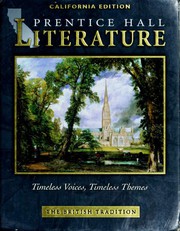
  4. Prentice Hall Literature - Timeless Voices, Timeless Themes - The British Tradition

    Kate Kinsella, Kevin Feldman, Colleen Shea-Stump Ph.D., Joyce Armstrong Carroll, Edward E. Wilson, Joseph Addison, Anna Akhmatova, Yehuda Amichai, Matthew Arnold, W. H. Auden, Jane Austen, Joanna Baillie, Bashö, Charles Baudelaire, Bede, Bei Dao, James Berry, Tony Blair, William Blake, Eavan Boland, Robert Bolt, Jorge Luis Borges, James Boswell, Elizabeth Bowen, Charlotte Brontë, Emily Brontë, Brooke, Rupert, Elizabeth Barrett Browning, Robert Browning, Robert Burns, Buson Yosa, Lord Byron, Tracy Chapman, Geoffrey Chaucer, Winston S. Churchill, Arthur C. Clarke, Samuel Taylor Coleridge, Confucius, Joseph Conrad, Daniel Defoe, Anita Desai, Charles Dickens, John Donne, T. S. Eliot, Elizabeth l, Queen of England, Anne Finch, Mohandas Karamchand Gandhi, Nadine Gordimer, Thomas Gray, Graham Greene, Thomas Hardy, Seamus Heaney, Heinrich Heine, Robert Herrick, Ὅμηρος, Gerard Manley Hopkins, A. E. Housman, Ken Hughes, Ted Hughes, Kobayashi, Issa, Thomas Jefferson, Francis Jeffrey, Samuel Johnson, Ben Jonson, James Joyce, John Keats, Rudyard Kipling, Amelia Lanier, Philip Larkin, D. H. Lawrence, Doris Lessing, Richard Lovelace, Thomas Babington Macaulay, Louis MacNeice, Thomas Malory, Christopher Marlowe, Andrew Marvell, Catherine McGuinness, John Milton, Thomas More, Saki, V. S. Naipaul, Pablo Neruda, Sir Isaac Newton, George Orwell, Ovid, Wilfred Owen - undifferentiated, Margaret Paston, Samuel Pepys, Francesco Petrarca, Edgar Allan Poe, Alexander Pope, Anna Quindlen, Walter Raleigh, Redgrove, Peter., Arthur Rimbaud, Sappho, Siegfried Sassoon, William Shakespeare, Mary Shelley, Percy Bysshe Shelley, Sir Philip Sidney, Alan Sillitoe, Stevie Smith, Sydney Smith, Sophocles, Muriel Spark, Stephen Spender, Edmund Spenser, Suckling, John Sir, Jonathan Swift, Alfred Lord Tennyson, Dylan Thomas, Emma Thompson, William Trevor, Tu Fu, Suzanne Vega, Derek Walcott, Mary Wollstonecraft, Virginia Woolf, William Wordsworth and William Butler Yeats

    1305 pages2002