Robert Burns

1759–17963 books here

Find authors like Robert

About Robert Burns

Robert Burns (also known as Rabbie Burns, Scotland's favourite son, the Ploughman Poet, the Bard of Ayrshire and in Scotland as simply The Bard) was a Scottish poet and a lyricist. He is widely regarded as the national poet of Scotland, and is celebrated worldwide. He is the best known of the poets who have written in the Scots language, although much of his writing is also in English and a "light" Scots dialect, accessible to an audience beyond Scotland. He also wrote in standard English, and in these pieces, his political or civil commentary is often at its most blunt.

He is regarded as a pioneer of the Romantic movement and after his death became a great source of inspiration to the founders of both liberalism and socialism. A cultural icon in Scotland and among the Scottish Diaspora around the world, celebration of his life and work became almost a national charismatic cult during the 19th and 20th centuries, and his influence has long been strong on Scottish literature. In 2009 he was voted by the Scottish public as being the Greatest Scot, through a vote run by Scottish television channel STV.

Biography from Open Library.

Robert Burns books in order

  1. The Poetical Works of Robert Burns

    Robert Burns

    Poetry written by the Scottish author Robert Burns.

    373 pages1786

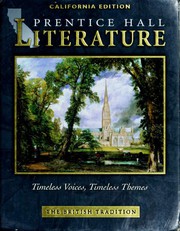
  2. Prentice Hall Literature - Timeless Voices, Timeless Themes - The British Tradition

    Kate Kinsella, Kevin Feldman, Colleen Shea-Stump Ph.D., Joyce Armstrong Carroll, Edward E. Wilson, Joseph Addison, Anna Akhmatova, Yehuda Amichai, Matthew Arnold, W. H. Auden, Jane Austen, Joanna Baillie, Bashö, Charles Baudelaire, Bede, Bei Dao, James Berry, Tony Blair, William Blake, Eavan Boland, Robert Bolt, Jorge Luis Borges, James Boswell, Elizabeth Bowen, Charlotte Brontë, Emily Brontë, Brooke, Rupert, Elizabeth Barrett Browning, Robert Browning, Robert Burns, Buson Yosa, Lord Byron, Tracy Chapman, Geoffrey Chaucer, Winston S. Churchill, Arthur C. Clarke, Samuel Taylor Coleridge, Confucius, Joseph Conrad, Daniel Defoe, Anita Desai, Charles Dickens, John Donne, T. S. Eliot, Elizabeth l, Queen of England, Anne Finch, Mohandas Karamchand Gandhi, Nadine Gordimer, Thomas Gray, Graham Greene, Thomas Hardy, Seamus Heaney, Heinrich Heine, Robert Herrick, Ὅμηρος, Gerard Manley Hopkins, A. E. Housman, Ken Hughes, Ted Hughes, Kobayashi, Issa, Thomas Jefferson, Francis Jeffrey, Samuel Johnson, Ben Jonson, James Joyce, John Keats, Rudyard Kipling, Amelia Lanier, Philip Larkin, D. H. Lawrence, Doris Lessing, Richard Lovelace, Thomas Babington Macaulay, Louis MacNeice, Thomas Malory, Christopher Marlowe, Andrew Marvell, Catherine McGuinness, John Milton, Thomas More, Saki, V. S. Naipaul, Pablo Neruda, Sir Isaac Newton, George Orwell, Ovid, Wilfred Owen - undifferentiated, Margaret Paston, Samuel Pepys, Francesco Petrarca, Edgar Allan Poe, Alexander Pope, Anna Quindlen, Walter Raleigh, Redgrove, Peter., Arthur Rimbaud, Sappho, Siegfried Sassoon, William Shakespeare, Mary Shelley, Percy Bysshe Shelley, Sir Philip Sidney, Alan Sillitoe, Stevie Smith, Sydney Smith, Sophocles, Muriel Spark, Stephen Spender, Edmund Spenser, Suckling, John Sir, Jonathan Swift, Alfred Lord Tennyson, Dylan Thomas, Emma Thompson, William Trevor, Tu Fu, Suzanne Vega, Derek Walcott, Mary Wollstonecraft, Virginia Woolf, William Wordsworth and William Butler Yeats

    1305 pages2002