Arthur C. Clarke
1917–200839 books here
About Arthur C. Clarke
Sir Arthur Charles Clarke CBE FRAS was a British science fiction writer, science writer and futurist, inventor, undersea explorer, and television series host.
He is famous for being co-writer of the screenplay for the 1968 film 2001: A Space Odyssey, widely considered to be one of the most influential films of all time. Clarke was a science writer, who was both an avid populariser of space travel and a futurist of uncanny ability. On these subjects he wrote over a dozen books and many essays, which appeared in various popular magazines. In 1961 he was awarded the Kalinga Prize, an award which is given by UNESCO for popularising science. These along with his science fiction writings eventually earned him the moniker "Prophet of the Space Age". His other science fiction writings earned him a number of Hugo and Nebula awards, which along with a large readership made him one of the towering figures of science fiction. For many years Clarke, Robert Heinlein and Isaac Asimov were known as the "Big Three" of science fiction.
Clarke was a lifelong proponent of space travel. In 1934, while still a teenager, he joined the British Interplanetary Society. In 1945, he proposed a satellite communication system using geostationary orbits. He was the chairman of the British Interplanetary Society from 1946–1947 and again in 1951–1953.
Biography from Open Library.
Arthur C. Clarke books in order
The Sands of Mars
Martin Gibson, a famous science fiction author, is travelling to Mars, as a guest of the crew of the spaceship Ares.
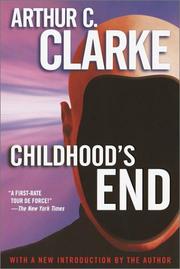
Childhood’s End
Childhood's End is a 1953 science fiction novel by British author Arthur C. Clarke. The story follows the peaceful alien invasion of Earth by the mysterious Overlords, whose arrival ends all war, helps form a world…
Islands in the Sky
When young Roy Malcolm won the Aviation Quiz Contest, the sponsor, World Airways, never dreamed he could legally claim a trip to the Inner Space Station as his prize.
Rendezvous with Rama
Written in 1973, a massive 50 kilometre long alien cylinder begins to pass through the solar system provoking a hurried effort to intercept it.
Expedition to Earth
This collection of Clarke’s work was originally published in 1953, when it was selected as one of the best science fiction books of the year by Boucher and McComas.
Earthlight
From back cover Del Rey paperback September 1991:
Reach for Tomorrow
A collection of short stories by Arthur C. Clarke, all of which were previously published at the time of this publication.
A Fall of Moondust
An early Arthur C. Clarke novel that takes place on the Moon. The setting is a future in which the Moon has become a tourist destination, and one of the attractions is a huge dust bowl on which one can sightsee from a…
Profiles of the future
This book originally appeared in 1962, and was based on essays written during the period 1959 - 1961.
Tales of Ten Worlds
Fifteen stories by Clarke, ranging from the infinite, somewhat startling possibilities of telecommunications satellites like Telstar, to life six thousand years from now.
Dolphin Island
A seventeen-year-old boy becomes involved in communication experiments with dolphins off the Great Barrier Reef.
2001
A novel that proposes an idea about how the human race might have begun and where it might be headed...given a little help from out there.
The Lost Worlds of 2001
Includes chapters on the making of the film '2001'.
Imperial Earth
Duncan Makenzie is the latest generation of the 'first family' of Titan, a colonised moon of Saturn.
The Fountains of Paradise
In the 22nd century visionary scientist Vannevar Morgan conceives the most grandiose engineering project of all time, and one which will revolutionize the future of humankind in space: a Space Elevator, 36,000…
2010, odyssey two
When 2001: A Space Odyssey first shocked, amazed, and delighted millions in the late 1960s, the novel was quickly recognized as a classic.
Great Short Tales of Mystery and Terror
Each story in Great Short Tales of Mystery and Terror is an example of the work of an outstanding author--from Edgar Allan Poe and Sir Arthur Conan Doyle to such modern masters as Agatha Christie, Ross Macdonald…
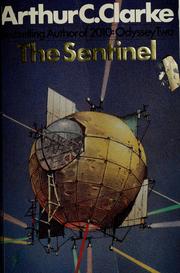
The Sentinel
From the Introduction...
The Songs of Distant Earth
The paradise of Thalassa is threatened by an evolutionary event brewing beneath the calm seas and by a spacecraft of refugees hovering in orbit above the planet.
2061
A re-visitation of the imaginative future painted by Arthur C. Clarke in his previous two books 2001: A Space Odyssey and 2010: Odyssey two.
Rama II
From the back cover of Bantam paperback December 1990:
The Garden of Rama
Book 3 of Clarke's Rama series is about an alien ghost ship that enters the solar system. This book picks up with the story of the crew who stayed aboard Rama at the end of Rama 2.
The Hammer of God
In the year 2110 technology has cured most of our worries. But even as humankind enters a new golden age, an amateur astronomer points his telescope at just the right corner of the night sky and sees disaster hurtling…
3001
A thousand years after the Jupiter Mission, astronaut Frank Poole is recovered and revived. He is intrigued by how much has changed. Then he receives a warning that the Monoliths have decided to destroy the human race.
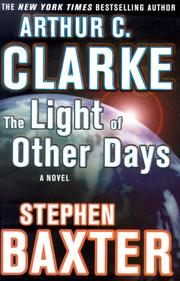
The Light of Other Days
From Arthur C. Clarke, the brilliant mind that brought us 2001: A Space Odyssey, and Stephen Baxter, one of the most cogent SF writers of his generation, comes a novel of a day, not so far in the future, when the…
The collected stories of Arthur C. Clarke
This work is a comprehensive collection of Sir Arthur C Clarke's short stories. Many of these stories were published in pulp sci-fi publications in the 1950s/60s.
The Collected Stories of Arthur C. Clarke
This is a collection of 114 stories written by Arthur C. Clarke. The UK version has a front cover with the title as "Arthur C. Clarke: The Collected Stories", and the USA version as "The Collected Stories of Arthur C.…
The Last Theorem
The final work from the brightest star in science fiction's galaxy. Arthur C Clarke, who predicted the advent of communication satellites and author of 2001: A Space Odyssey completes a lifetime career in science…