Mary Wollstonecraft

1759–17973 books here

Find authors like Mary

About Mary Wollstonecraft

Mary Wollstonecraft (pronounced /ˈwʊlstən.krɑːft/; 27 April 1759 – 10 September 1797) was an eighteenth-century British writer, philosopher, and advocate of women's rights. During her brief career, she wrote novels, treatises, a travel narrative, a history of the French Revolution, a conduct book, and a children's book. Wollstonecraft is best known for A Vindication of the Rights of Woman (1792), in which she argues that women are not naturally inferior to men, but appear to be only because they lack education. She suggests that both men and women should be treated as rational beings and imagines a social order founded on reason.

Biography from Open Library.

Mary Wollstonecraft books in order

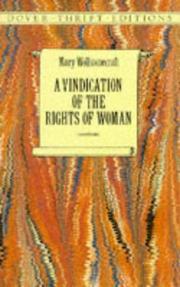
  1. A Vindication Of The Rights Of Woman

    Mary Wollstonecraft

    From Goodreads: Writing in an age when the call for the rights of man had brought revolution to America and France, Mary Wollstonecraft produced her own declaration of female independence in 1792.

    272 pages1792

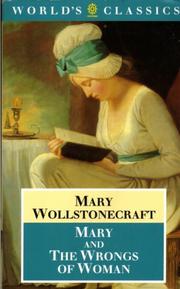
  2. Maria; or, The Wrongs of Woman

    Mary Wollstonecraft

    Maria: or, The Wrongs of Woman is the 18th-century British feminist Mary Wollstonecraft’s unfinished novelistic sequel to her revolutionary political treatise A Vindication of the Rights of Woman (1792).
    157 pages1799

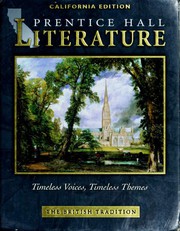
  3. Prentice Hall Literature - Timeless Voices, Timeless Themes - The British Tradition

    Kate Kinsella, Kevin Feldman, Colleen Shea-Stump Ph.D., Joyce Armstrong Carroll, Edward E. Wilson, Joseph Addison, Anna Akhmatova, Yehuda Amichai, Matthew Arnold, W. H. Auden, Jane Austen, Joanna Baillie, Bashö, Charles Baudelaire, Bede, Bei Dao, James Berry, Tony Blair, William Blake, Eavan Boland, Robert Bolt, Jorge Luis Borges, James Boswell, Elizabeth Bowen, Charlotte Brontë, Emily Brontë, Brooke, Rupert, Elizabeth Barrett Browning, Robert Browning, Robert Burns, Buson Yosa, Lord Byron, Tracy Chapman, Geoffrey Chaucer, Winston S. Churchill, Arthur C. Clarke, Samuel Taylor Coleridge, Confucius, Joseph Conrad, Daniel Defoe, Anita Desai, Charles Dickens, John Donne, T. S. Eliot, Elizabeth l, Queen of England, Anne Finch, Mohandas Karamchand Gandhi, Nadine Gordimer, Thomas Gray, Graham Greene, Thomas Hardy, Seamus Heaney, Heinrich Heine, Robert Herrick, Ὅμηρος, Gerard Manley Hopkins, A. E. Housman, Ken Hughes, Ted Hughes, Kobayashi, Issa, Thomas Jefferson, Francis Jeffrey, Samuel Johnson, Ben Jonson, James Joyce, John Keats, Rudyard Kipling, Amelia Lanier, Philip Larkin, D. H. Lawrence, Doris Lessing, Richard Lovelace, Thomas Babington Macaulay, Louis MacNeice, Thomas Malory, Christopher Marlowe, Andrew Marvell, Catherine McGuinness, John Milton, Thomas More, Saki, V. S. Naipaul, Pablo Neruda, Sir Isaac Newton, George Orwell, Ovid, Wilfred Owen - undifferentiated, Margaret Paston, Samuel Pepys, Francesco Petrarca, Edgar Allan Poe, Alexander Pope, Anna Quindlen, Walter Raleigh, Redgrove, Peter., Arthur Rimbaud, Sappho, Siegfried Sassoon, William Shakespeare, Mary Shelley, Percy Bysshe Shelley, Sir Philip Sidney, Alan Sillitoe, Stevie Smith, Sydney Smith, Sophocles, Muriel Spark, Stephen Spender, Edmund Spenser, Suckling, John Sir, Jonathan Swift, Alfred Lord Tennyson, Dylan Thomas, Emma Thompson, William Trevor, Tu Fu, Suzanne Vega, Derek Walcott, Mary Wollstonecraft, Virginia Woolf, William Wordsworth and William Butler Yeats

    1305 pages2002